
Sales Funnel Stages and the Landing Page Behind Each
Your landing page is usually the first point in a sales funnel where a buyer decides whether to keep going or leave.
Your landing page is usually the first point in a sales funnel where a buyer decides whether to keep going or leave. If the page asks for a demo from someone who arrived five minutes ago, most of them leave. If it asks for nothing, nobody progresses. The job is to match the page and the offer to where the buyer actually is, then measure what happens between each step so you know where people stall.
This guide walks through the stages a B2B or SaaS buyer passes through from first visit to signed deal, the page and offer each stage needs, what to measure in the gaps, and a worked example you can copy. The example is illustrative, not a case study, and every number in it is made up to show the method.
1. The decision in plain words
A sales funnel is the ordered set of steps a buyer takes from not knowing you exist to paying you, and each step has its own page, its own offer and its own reason to continue. The decision you are making is not "how do I get more traffic." It is "which step is losing the most people, and what page or offer fixes that step."
Most funnels break in one of two ways. Either the offer is too heavy for the stage (a cold visitor asked to book a sales call), or the handoff between stages is missing (a lead who downloads a guide and never hears from anyone again). Both are visible in the numbers once you measure stage to stage rather than looking at a single conversion rate for the whole page.
Before you redesign anything, map where a real visitor enters and where they currently drop. If you have not planned the pages as a route yet, building a visual sitemap with Octopus.do makes the stages and their pages concrete.
2. The sales funnel stages, start to finish
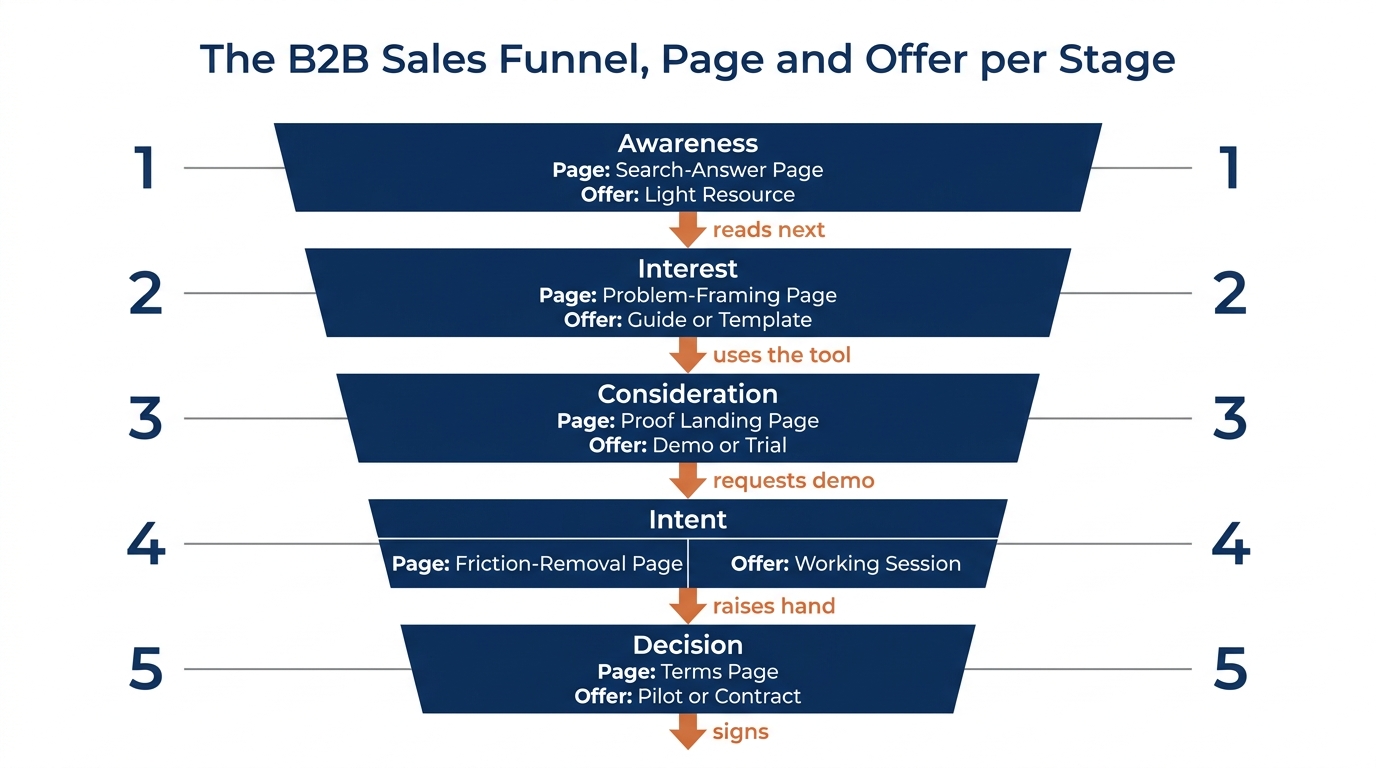
A B2B or SaaS sales funnel usually runs through five or six stages. The names vary, but the buyer's state of mind does not. Here is each stage, who is acting, the page it needs and the offer that fits.
- Awareness. The buyer has a problem and is searching. They need a page that answers the search and frames the solution. The offer is a next read or a lightweight resource.
- Interest. They are comparing approaches. They need a page that frames the problem and shows you understand their business model. The offer is a guide, a template or a tool they can use without talking to anyone.
- Consideration. They are evaluating you specifically. They need a landing page with proof, a clear use case and an honest view of fit. The offer is a demo, a trial or a scoped assessment.
- Intent. They have raised a hand. They need a page or follow-up that removes friction: pricing logic, security answers, an easy way to involve their team. The offer is a working session or a proposal.
- Decision. They are choosing between you and one alternative. They need the terms, the scope and a low-risk way to start. The offer is a signed agreement or a paid pilot.
If you want the page type that maps to each marketing stage before a lead becomes sales-qualified, we cover it in detail in The Marketing Funnel Stage by Stage With the Page Each Stage Needs.
3. How to build a sales funnel one stage at a time
Do not build all five stages at once. Build the stage that touches your landing page first, because that is where you can see results fastest, then work outward.
Start at the stage where you already have traffic
Find the page people actually land on and decide which funnel stage it serves. A page ranking for a problem keyword serves Awareness or Interest, so its offer should be a read or a resource. A demo request does not fit because the visitor has not evaluated options yet. A page people reach after clicking a branded ad serves Consideration, so proof and a demo belong there.
Match one offer to one stage
Each page should ask for exactly one thing, and that thing should be one notch heavier than where the visitor is. A visitor reading about a problem can be asked to read the next thing or grab a template. Asking them to book a call skips two stages. The drop shows up as a page that gets traffic and no conversions.
Connect the handoff before you optimize anything
A lead who converts and then hears nothing is a leak no headline change will fix. Before you tune copy, confirm that every conversion triggers a next step: an email sequence, a task for sales, a follow-up offer. The landing page structure generator helps you lay out a single stage's page so the primary action is unmistakable and the next step is built in.
When you reach the point of actually building or rebuilding a stage's page, pick the tool that fits the stage from the directory of landing page builders rather than forcing every page through one vendor.
4. What to measure between the stages
The useful number is never the whole-funnel conversion rate. It is the pass-through rate between two adjacent stages, because that tells you which step to fix. Track the count entering a stage and the count moving to the next, and the weakest ratio is your first project.
Watch the gap, not the stage, for three reasons. A stage with low volume might still convert well. A stage with high volume might leak badly and still look busy. And a fix to the worst gap moves every downstream number, so it pays back more than tuning a stage that is already working.
5. The checks, in a table you can copy
Run these checks against your current funnel in order. Each row is a step, what to look for, and why it matters. Copy the table into your own doc and fill the last column with what you find.
| Step to check | What to look for | Why it matters |
|---|---|---|
| Entry point | Which stage does the page people land on actually serve? | A page ranking for a problem but pitching a demo is mismatched and loses the visitor. |
| Offer weight | Is the ask one notch heavier than the visitor's stage, not three? | Over-asking at a cold stage shows up as traffic with near-zero conversion. |
| Single action | Does the page ask for exactly one thing above the fold? | Competing calls to action split attention and lower the step's pass-through. |
| Handoff | Does every conversion trigger a defined next step? | A lead who hears nothing after converting is a leak no copy change fixes. |
| Stage-to-stage rate | What percentage moves from each stage to the next? | The weakest ratio is where the funnel is actually losing money. |
| Proof placement | Is evidence shown at Consideration, where fit is being judged? | Proof too early is ignored; too late, the buyer has already left. |
| Follow-up speed | How long between a raised hand and a human reply? | Intent decays fast; a slow reply hands the buyer back to a competitor. |
6. A worked example on a landing page, labeled as illustrative
This example is invented to show the method. The company and all numbers are made up. Treat the structure as the takeaway.
Imagine a B2B scheduling tool for clinics. Its main landing page ranks for a problem phrase and draws 4,000 visitors a month. The page's only button says "Book a demo." Here is how the stages looked before any fix.
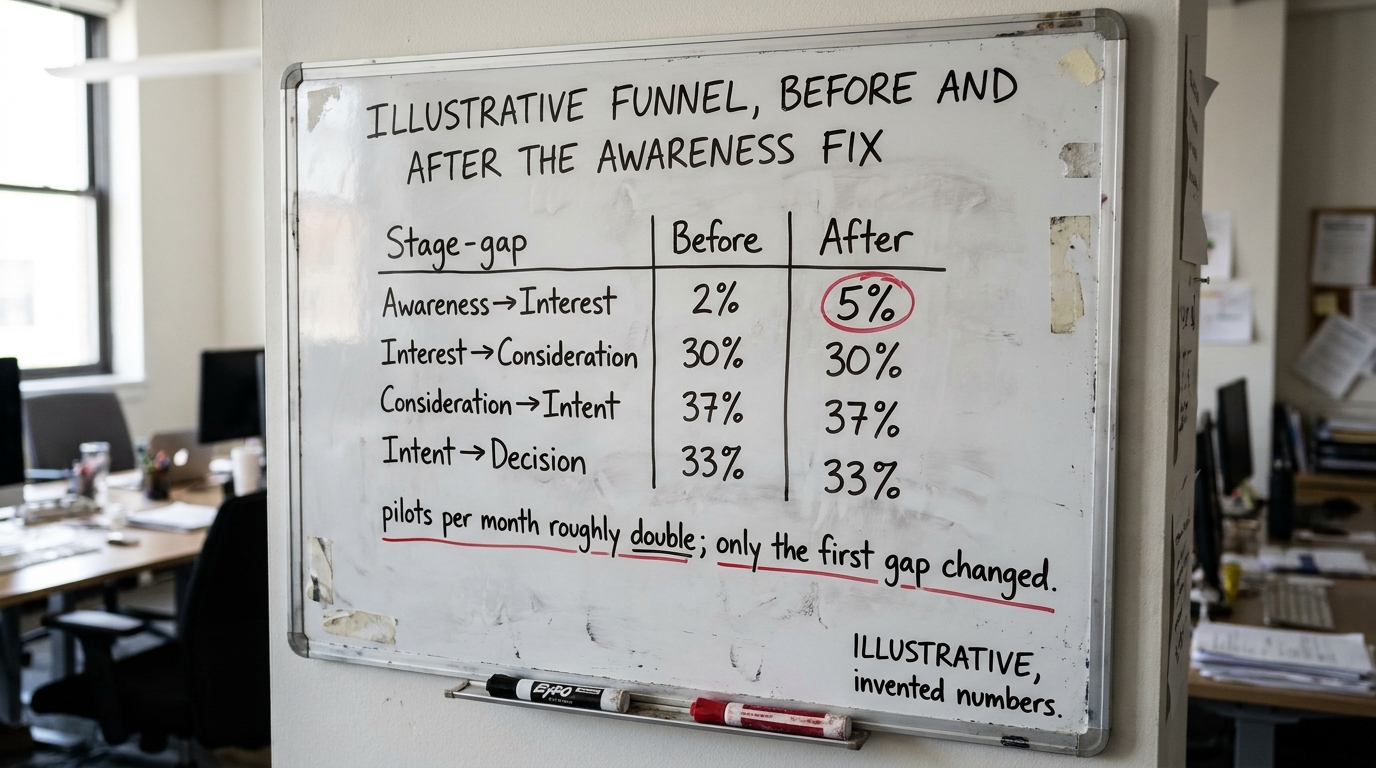
- Awareness to Interest: 4,000 visitors, 80 click through to a guide. That is 2 percent, and it is low because the page's only offer is a demo, which skips the Interest stage.
- Interest to Consideration: of 80 who read the guide, 24 request a demo. That is a healthy 30 percent once the right offer exists.
- Consideration to Intent: 24 demos, 9 ask for pricing. 37 percent.
- Intent to Decision: 9 pricing conversations, 3 pilots signed. 33 percent.
The worst gap is the first one, Awareness to Interest. The team adds a lightweight resource, a clinic-staffing template, as the primary action on the top-of-funnel page, and moves the demo button down to a proof section for the minority who are ready.
After the change, suppose the Awareness-to-Interest rate moves from 2 percent to 5 percent. Hold every downstream rate constant and the monthly pilots roughly double, because each later stage is working on a larger base. One fix at the weakest gap moved the whole funnel. That is why you measure the gaps rather than the page as a whole. For page layouts that do this well, the landing page examples collection is a useful reference, and a focused single-offer page like the tiny landing page example shows the one-action discipline in practice.
7. A sales funnel template you can reuse
Once you have fixed the worst gap, document the funnel so you can repeat it for the next product or segment. A workable sales funnel template is just four columns per stage: the stage name, the page that serves it, the single offer, and the pass-through rate you are tracking. Keep it in a spreadsheet next to the live numbers so a falling ratio is obvious.
This template also forces an honest conversation about where leads come from in the first place. If your Awareness stage is thin, the fix sits upstream in demand, and broader lead generation strategies matter more than another page edit.
For grounding on how buyers move through evaluation and what shortens or lengthens the path, firms that study deal behavior publish useful research. Bain's annual private equity report tracks how portfolio companies are measured on repeatable commercial engines, and McKinsey's private capital research and Bain's Global Private Equity Report both frame why predictable revenue mechanics, which is what a working funnel produces, carry weight with buyers and investors.
8. Where to start this week
Pick the one page that gets the most traffic and decide which funnel stage it serves. Check whether its single offer is one notch heavier than that stage or three. If it over-asks, replace the primary button with the lighter offer the stage actually needs, and move the heavier ask to a proof section lower down.
Then measure one gap. Count how many enter that page and how many take the next step for a week, and write the rate in your template. That single number tells you whether your first fix worked and where the next one belongs.
When you are ready to lay out the page for a specific stage, start with the landing page structure generator in the Landing Page FYI library and build from the stage you chose outward.
Newsletter
New landing page examples, tools and tests in your inbox
One email when something worth studying lands in the library. No spam, unsubscribe any time.